
Serving HOAs on Long Island since 1979


HOA Milling & Paving
Most HOA roads and parking lots are built together and wear out together. After 25 years, since it was originally installed, this year we milled and repaved the entrances, roadways and parking areas of Silver Village in Aquebogue.
We removed 2 inches of the worn surface, repaired what is underneath, and layed fresh asphalt in phases so residents can still get to their homes.

HOA Asphalt Questions
How much does it cost to repave or seal coat an HOA parking lot?
Cost depends heavily on square footage, current condition, and how much work is needed — a sealcoating job and a full milling-and-repaving project are very different price points.
The clearest way to budget is a walk-through estimate of the actual property, which breaks the work into what needs doing this cycle versus what can be planned for later.
How often should an HOA sealcoat or repave its roads and parking lots?
A typical cycle is sealcoating every 2 to 3 years, with a full milling and repaving every 15 to 25 years, depending on climate, traffic volume, and how well the base was originally built. Long Island’s freeze-thaw winters wear pavement faster than warmer climates do.
A pavement condition assessment is the most reliable way to know where a specific property actually stands, rather than going by age alone.
What’s the difference between milling and a full-depth reconstruction?
Milling removes just the top layer or two of worn asphalt and replaces it with fresh asphalt on top of the existing, still-sound base — faster, less disruptive, and what most HOA road and lot refreshes actually need.
Full-depth reconstruction removes everything down to the subbase and rebuilds from the ground up, which is only necessary when the base itself has failed. The Build / Maintain / Repair / Renew breakdown above shows which category a given job falls into.

HOA Sealcoating
This is an HOA community in Islip Terrace. Faded, oxidized asphalt, worn ADA markings, and cracked pavement — common after a few Long Island winters without maintenance.
PaveMaster sealed, crack-filled, and restriped the entire lot. Drag the slider to see the difference.


What does sealcoating actually do — and what doesn't it do?
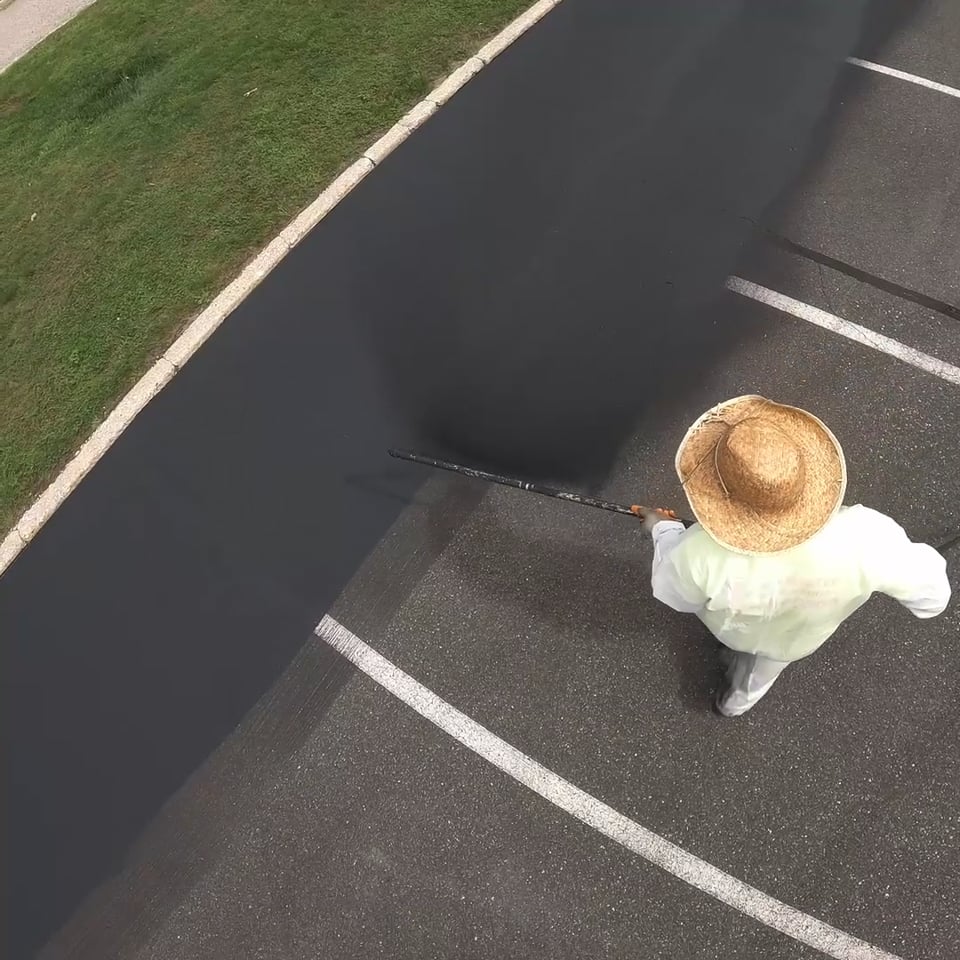
Sealcoating applies a thin protective layer over existing asphalt, sealing surface pores against water, UV rays, oil, and road salt. It slows oxidation, keeps the pavement flexible longer, and gives the lot a clean, jet-black appearance that tells tenants and customers the property is maintained.
What it doesn't do: fix structural problems. Sealcoating won't hold together cracked or crumbling pavement — it goes over sound asphalt. If your lot has significant cracking, that gets addressed first with asphalt repair or pothole repair. Sealcoating is the final step, not the first one.
Why we use asphalt-based sealer — not coal tar
You may have noticed that some contractors offer a cheaper price and a blacker-looking finish. In most cases, that's coal tar sealer — and in New York State, it's now illegal.
New York banned coal tar pavement products effective November 2023 (ECL §37-0115). The reason: coal tar sealer contains PAHs — polycyclic aromatic hydrocarbons — at concentrations far higher than asphalt-based products. PAHs are classified human carcinogens that wash into stormwater and accumulate in soil.
PaveMaster uses asphalt-emulsion sealer — the legally compliant, commercially proven product. If a contractor is quoting coal tar in New York today, they're quoting an illegal product.
Crack sealing — why it comes first
Sealcoating over open cracks is a mistake. Water will find them, and freeze-thaw cycles will make them worse regardless of what's on the surface.
The correct sequence: crack sealing first, then sealcoating. We fill cracks with hot-pour rubberized sealant that flexes with temperature changes rather than becoming brittle. Skipping this step is common among lower-bid contractors. It's the reason those jobs look fine in May and start failing by October.
Line striping — why we do it at the same time
Fresh sealcoat is the right moment to restripe. The surface is clean, the sealer has cured, and new lines bond to a uniform surface rather than a patchwork of old markings and faded asphalt.
PaveMaster handles striping as part of the same mobilization — parking stalls, fire lanes, directional arrows, and ADA-compliant accessible markings. One crew, one visit. Property managers who split sealcoating and striping between separate contractors often end up with scheduling gaps and ADA markings that don't meet current dimensional standards.
How often does a parking lot need sealcoating?
The typical recommendation for commercial parking lots is every 2–3 years, depending on traffic volume and sun exposure. South-facing lots and high-turnover retail properties may need it closer to every two years. Lower-traffic HOA lots with good drainage can often go three.
The tell: when the surface starts showing gray oxidation and the aggregate begins to show through, you're at or past the right window. Waiting until the pavement looks visibly weathered means the sealer has less to bond to and you've already lost some pavement life.
What to expect on the day of the job
Sealcoating requires the lot to be closed to traffic for curing — typically 24 hours, sometimes less depending on temperature and humidity. We coordinate with property managers on timing to minimize disruption. Early morning starts are standard.
The process: lot is blown clean of debris, cracks pre-treated if not already completed, sealer applied by spray or squeegee depending on lot condition, edges detailed by brush, lot coned off until cure is complete. Line striping follows once the sealer is fully cured, either same day or next morning depending on conditions.

HOA Sidewalk Replacement
Cracked, heaved or settled sidewalks are trip hazards and a liability for any community. We can replace entire HOAs sidewalks over a span of months or years. Replacing only the sections that have failed, without tearing up more than is needed, is another valid approach.

How a sidewalk replacement works
Saw cutting

Every replacement starts with clean, straight cuts. We saw cut along the joints and edges of the damaged slabs so the old concrete comes out without chipping the good sidewalk next to it, and the new section meets the existing walk cleanly.
Removal

The cracked, heaved or settled slabs are broken out and hauled away with compact equipment sized for community walkways. We protect lawns, landscaping and nearby surfaces as we work, and look at what is under the old walk to find out why it failed, whether that was settling, tree roots or drainage.
Preparing

New concrete is only as good as what is under it. We grade and compact the base, correct low spots so water drains away from the walk, and set forms to the right line, width and slope, including ADA-compliant pitch where ramps and crossings require it.
Pouring Concrete

Concrete is delivered by truck and placed by our crew, using chutes and wheelbarrows to reach walkways a truck cannot get close to. We place it in sections with control joints so the slab can move without cracking at random, and we coordinate access with your property manager and residents before the pour.
Finishing

The surface is leveled, floated and given a broom finish for slip resistance. Edges are tooled, joints are cut, and cones and barriers go up so the fresh concrete stays protected. The work area is left clear and clean at the end of each day.
Curing time
Fresh concrete needs time, and weather changes it. As a general guide, a new sidewalk is ready for foot traffic in about 24 to 48 hours and reaches full strength at around 28 days. We tell your board and residents exactly when the walk can be used, and keep it protected until then.


 Asphalt
 Concrete
 Masonry
 Drainage